How to plan a group pickleball game night in Klang Valley
By Sarah · Updated 2026-06-29
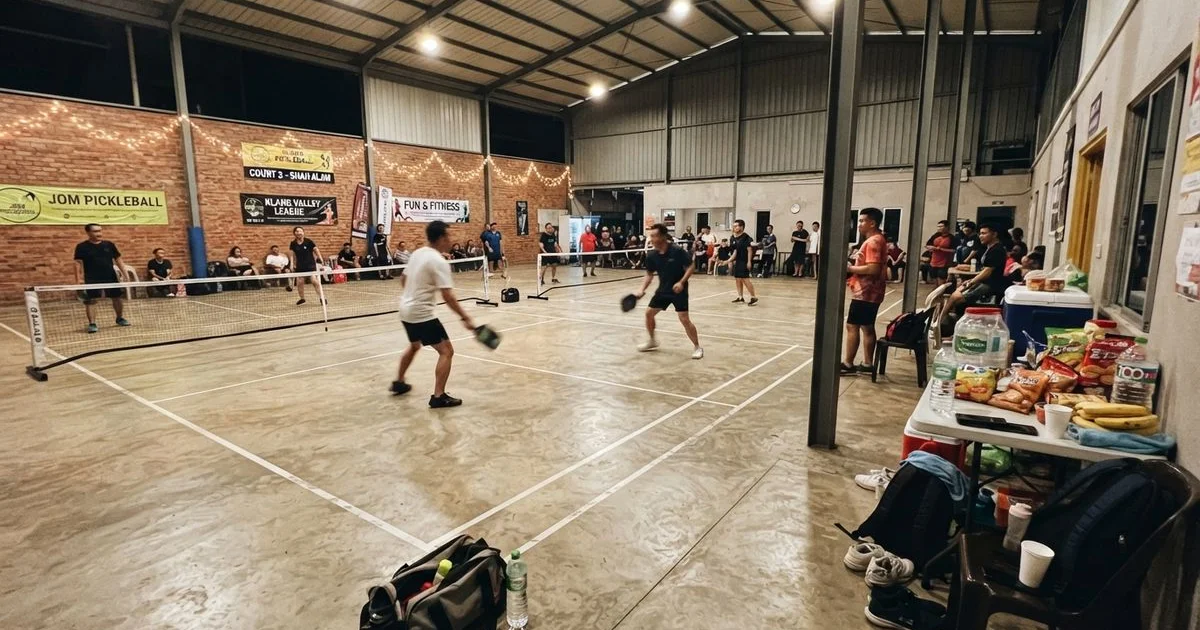
Organising pickleball for a group of friends is simple once you’ve done it a couple of times, but the first attempt often runs into avoidable friction: not enough courts booked, an awkward cost split, or players standing around waiting their turn. This guide covers the practical planning that makes a group session run smoothly.
Working out how many courts you need
Doubles is the standard format for casual group play, with four players per court. A rough rule of thumb: divide your total headcount by four to get the minimum number of courts, then add one extra court if you can, so players rotating off one game aren’t standing around waiting the whole time.
| Group size | Minimum courts (doubles) | Comfortable courts (with rotation room) |
|---|---|---|
| 8 players | 2 | 3 |
| 16 players | 4 | 5 |
| 24 players | 6 | 7 |
Booking multiple courts at one venue
Not every venue can accommodate a large group booking on short notice, especially during peak evening and weekend hours. Reaching out at least a week in advance gives the venue time to block off adjacent courts for your group, and it’s worth asking directly whether they can hold several courts together rather than scattered slots. If you’re booking outdoor courts, keep an eye on the forecast too. Our rainy season guide covers how to plan around sudden weather changes.
Splitting the cost fairly
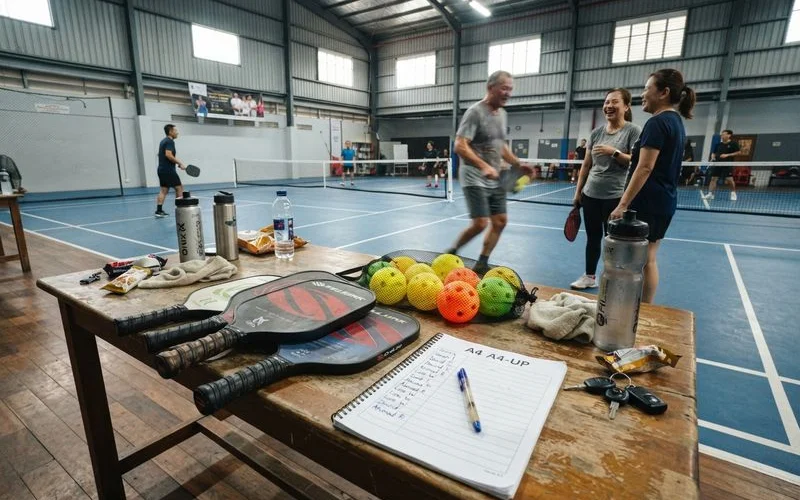
The simplest approach is dividing the total court fee evenly across everyone attending, collected ahead of time or on the night. If some players need rental paddles and others bring their own, it’s fairer to charge rental fees only to those using them rather than folding it into the even split. For a recurring group, some organisers keep a simple running tally so nobody has to chase payments session to session.
Structuring the night so everyone plays
For a genuinely social game night, rotating partners and opponents every game or two keeps things fresh and avoids the same pairing dominating the evening. A simple approach: after each game, the winning pair splits up and joins two different players for the next round. This also naturally mixes skill levels rather than letting the strongest players monopolise one court all night.
Planning for a mixed-skill group
If your group spans complete beginners to experienced players, it’s worth setting expectations before the night starts. Either run a separate beginner-friendly court for newer players to get comfortable, or rotate skill levels across courts every round so nobody feels stuck facing opponents well above or below their level for the whole session.
Making it a regular thing
Groups that turn a one-off game night into a recurring habit usually settle on a fixed day and venue, which makes booking easier over time since the venue gets used to holding the same slot. It also builds a natural rhythm for skill improvement, since players who show up regularly progress faster than those playing sporadically.
Handling no-shows and last-minute changes
Group bookings run into one predictable problem: someone drops out at the last minute after courts and costs are already locked in. Building a simple buffer into your planning helps, either a short waitlist of players happy to join on short notice, or an agreement upfront that the group absorbs a no-show’s share of the cost rather than scrambling to recalculate on the night. For a recurring group, setting this expectation once at the start saves an awkward conversation every time it comes up.
Choosing a venue that suits your group’s style
Beyond just having enough courts, some venues suit a social group night better than others. Look for a venue with a shared waiting area where players not currently on court can comfortably watch and chat, decent parking for a larger group arriving around the same time, and staff comfortable managing a big group booking without it feeling like a logistical headache for either side. A quick call ahead to check these details saves surprises on the night.
Browse courts across Klang Valley that can accommodate group bookings, and check our ranking methodology for how we score venues on facility capacity and group-friendliness.
FAQ
- How many courts do I need for a group of 16 players?
- For doubles play, which is standard for casual games, plan on roughly four players per court, so a group of 16 needs around four courts running at once for everyone to play without long waits.
- How far in advance should I book courts for a group session?
- Popular evening and weekend slots can fill up, so booking at least a week ahead is a safe habit for a group of six or more, especially if you need multiple courts at the same venue.
- What's a fair way to split the cost across the group?
- Dividing the total court fee evenly by the number of players is the simplest approach. If some players also rent paddles, it's fairer to bill rental fees only to those who actually use them.
- Should beginners and experienced players be on the same court?
- Mixing skill levels works fine for a casual, social game night, but if your group has a wide skill range, rotating players between courts every game or two keeps things fun for everyone rather than lopsided matches all night.